

Published On: 2026-03-26Categories: Blog

Running a small charity in the UK often feels like trying to solve an impossible puzzle: you need money to raise money. Traditional fundraising methods require upfront investment for events, materials, or marketing—but if you had that budget, you wouldn’t need to fundraise in the first place. It’s a frustrating paradox that leaves many small charities stuck, unable to access the funding they desperately need to support their communities.

The good news? Fundraising without a budget isn’t just possible—it’s how many of the UK’s most successful charities got started. This guide shares seven practical, no-budget fundraising ideas specifically designed for small charities with limited resources. Whether you’re a youth organization, community group, or local support service, you’ll find actionable strategies you can start implementing today.

In This Guide:

Why Traditional Fundraising Fails Small Charities

The upfront cost barrier.

Charity dinners need venue deposits. Sponsored walks require insurance and promotional materials. Even online crowdfunding campaigns work best with professional photos and videos. When you’re operating on a shoestring budget, these costs can feel insurmountable.

The expertise gap.

Successful fundraising requires skills in marketing, event management, donor relations, and financial planning. Small charities rarely have staff with this specialized knowledge, and hiring consultants is—you guessed it—expensive.

Time and volunteer capacity.

Large fundraising events demand hours of planning, coordination, and execution. Small charities often rely on a handful of dedicated volunteers who already wear multiple hats. Adding a time-intensive fundraiser to their plates simply isn’t feasible.

Finally, many traditional methods assume you have an established donor base to tap into. But if you’re a newer charity or serve a niche community, building that base from scratch while simultaneously trying to fundraise creates a chicken-and-egg situation.

The solution? Focus on fundraising methods that require zero upfront investment, minimal time, leverage the skills you already have, and help you build supporter relationships as you go.

7 No-Budget Fundraising Ideas for UK Charities
1. Product-based fundraising with no upfront costs

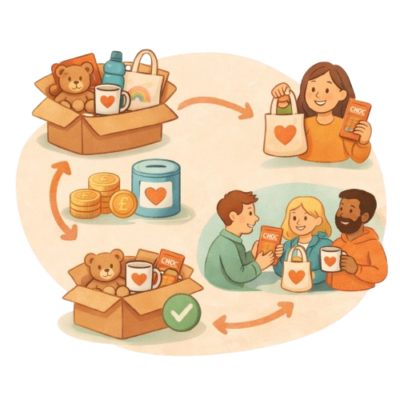
Product-based fundraising offers one of the most accessible entry points for small charities because it removes financial risk entirely. Here’s how it works: your charity partners with a supplier who provides products at cost with no upfront payment required. Your supporters sell these products to their friends, family, and colleagues, and your charity keeps the profit. Unsold items can typically be returned at no cost.

This model works particularly well for small charities because it’s completely scalable. You can start with just ten items or scale up to hundreds depending on your volunteer capacity. The products do the “asking” for you, instead of requesting donations, your supporters are offering something tangible that people genuinely want.

What makes this especially powerful is that it turns your supporters into active fundraisers. Rather than relying on a few committee members to organize a big event, you’re distributing the fundraising effort across your entire community. Each supporter sells within their own personal network, dramatically expanding your reach without requiring you to build a huge donor database.

planning a fundraiser

Popular product options include candles, eco-friendly items, or seasonal goods. The key is choosing something high-quality that people will be happy to purchase, not just out of charity but because they genuinely want the product. When done right, product-based fundraising can generate unrestricted income that you can use wherever your charity needs it most, whether that’s operational costs, a specific project, or building your reserves.

Learn about how risk-free product fundraising works →

2. Community Partnership Fundraising

Local businesses, schools, and community organisations often have resources they can share even when they can’t offer cash donations. These partnerships cost you nothing but can provide significant value.

Reach out to local businesses for in-kind donations: a café might donate their space for a community event, a print shop might design and print your promotional materials for free, or a local store might display collection tins at their checkout. The key is making it easy for them to help and showing how their support benefits the local community they serve.

Schools and universities are excellent partners because they’re always looking for meaningful ways to engage students. Student groups might choose your charity as their year’s fundraising focus, organising sponsored challenges or donation drives that require no financial input from you.

planning a fundraiser

Community centers, libraries, and faith organisations often have free meeting spaces you can use for planning sessions, volunteer recruitment events, or small fundraising activities. They may also promote your work through their networks, giving you access to audiences you couldn’t reach on your own.

3. Skills-Based Volunteering for Fundraising Support

Every charity has tasks that require specialised skills—grant writing, social media management, graphic design, website maintenance, financial planning. Paying for these services is expensive, but many professionals are willing to donate their expertise.

Platforms like Reach Volunteering and Doit.life connect charities with skilled volunteers across the UK. You might find a marketing professional who can develop your fundraising strategy, an accountant who can help with grant applications, or a web designer who can improve your donation page, all pro bono.

The beauty of skills-based volunteering is that it doesn’t just save money in the short term; it builds your charity’s capacity for long-term sustainability. A volunteer who helps you set up effective fundraising systems creates infrastructure that continues generating value long after their involvement ends.

planning a fundraiser

4. Social Media Fundraising Campaigns

Social media platforms offer completely free tools for fundraising that can reach thousands of potential supporters. Facebook Fundraisers allow your supporters to create fundraising campaigns for your charity directly from their profiles, often for birthdays or personal milestones. You don’t need to do anything except have a Facebook page—your supporters do all the work.

Instagram and TikTok are powerful for storytelling. Share short videos showing your charity’s impact, introduce the people you help (with permission), or take followers behind the scenes of your work. Compelling storytelling costs nothing but time and can inspire donations without any formal campaign.

Twitter/X threads explaining your mission, sharing impact statistics, or addressing misconceptions about the issues you tackle can go viral, bringing new supporters to your cause. The platform rewards authentic, informative content that sparks conversation.

planning a fundraiser

The key to successful social media fundraising is consistency and authenticity. You don’t need professional production quality, phone videos and genuine stories often perform better than polished corporate content. Post regularly, engage with comments, and make it incredibly easy for inspired followers to donate.

5. Local Business Sponsorship (In-Kind)

Even businesses that can’t donate cash often have resources they can share. Think creatively about what might be valuable to your charity beyond money.

A restaurant might provide food for your volunteers during a long planning day. A local gym might offer free memberships to staff who work stressful jobs. A printing company might produce your annual report. A photographer might document your events. All of these are costs you would otherwise pay, so securing them as in-kind sponsorship is essentially the same as raising money.

When approaching businesses, lead with the community benefit and the recognition they’ll receive. Most local businesses want to be seen as community supporters, so offering to feature their logo on your materials, mention them in social media posts, or include them in press releases gives them valuable exposure in exchange for their support.

planning a fundraiser

Start with businesses that have a natural connection to your cause. If you support youth development, approach sports clubs, educational suppliers, or children’s activity providers. If you work with elderly people, connect with healthcare companies, accessibility equipment providers, or retirement living services.

6. Peer-to-Peer Fundraising

Peer-to-peer fundraising transforms your supporters into fundraisers by empowering them to raise money on your behalf. This works particularly well for small charities because it leverages your supporters’ networks without requiring you to do the outreach.

The most common model is personal challenge fundraising: supporters sign up for a marathon, cycle ride, or other challenge and ask their friends and family to sponsor them. Your charity doesn’t organize the event, the supporter does all the work. Platforms like JustGiving & and GoFundMe make it easy for supporters to set up personal fundraising pages linked to your charity.

Birthday fundraisers are increasingly popular, especially on Facebook. Instead of gifts, people ask friends to donate to their chosen charity. This requires zero effort from your organisation beyond having a Facebook page and thanking donors

planning a fundraiser

The key to successful peer-to-peer fundraising is making it incredibly easy. Provide your supporters with:

  • Suggested wording for their fundraising pages
  • Images and statistics they can share
  • Prompt thank-yous when people donate through their pages

7. Grant Applications (Free Money)

While grant writing takes time, it requires no upfront financial investment and can secure significant funding. Many small charities overlook grants, assuming they’re too competitive or complicated, but thousands of small grants specifically target grassroots organisations like yours.

Start with local community foundations, which often have funds under £5,000 for local projects. These are less competitive than national grants and funders often prioritise supporting small, community-based charities over larger organisations.

Supermarket community grant schemes (Tesco Bags of Help, Asda Foundation, Morrisons Foundation) regularly fund small charities. Applications are straightforward, and awards typically range from £1,000 to £5,000.

The National Lottery Community Fund offers grants from £300 to £10,000 for projects that make a difference in local communities. While the application requires some effort, their online guides are clear and they explicitly encourage applications from small charities.

planning a fundraiser

Parish and town councils often have small grants available for local groups—sometimes as little as £500-£1,000, but perfect for small charities and usually very straightforward to apply for.

The secret to grant success isn’t fancy language or professional consultants—it’s clearly demonstrating need, explaining exactly what you’ll do with the money, and showing how you’ll measure impact. Many funders offer feedback on unsuccessful applications, so even rejections help you improve for next time.

How to Choose the Right Fundraising Approach for Your Charity

  • Volunteer capacity and time: Product-based fundraising and peer-to-peer approaches require less ongoing management than organising partnerships or running social media campaigns. If your volunteers are already stretched thin, choose methods that distribute the work or require minimal oversight.
  • Your supporter base: If you have engaged supporters willing to help, peer-to-peer fundraising and product sales leverage their networks effectively. If you’re still building your supporter community, focus on social media and local partnerships to increase visibility first.
  • Mission alignment: Choose fundraising methods that feel authentic to your work. A youth charity might naturally connect with schools and universities for partnerships. An environmental organisation might excel with eco-friendly product sales. An arts charity might find creative skills-based volunteers easily.
  • Speed of returns: Need money quickly? Product fundraising and social media campaigns can generate income within weeks. Building partnerships and applying for grants takes longer but can provide larger or more sustainable funding.

You don’t have to choose just one approach. Many successful small charities combine methods—using product fundraising for quick, flexible income while simultaneously building partnerships and applying for grants for longer-term funding.

Getting Started: Your First Steps

1. Assess your resources.

Even with no money, you have assets: passionate volunteers, community connections, social media followers, or simply your compelling mission. List what you do have, not what you lack.

2. Choose one idea.

Don’t try to implement everything at once. Pick the single approach that best matches your current capacity and supporter base.

3. Set a realistic goal.

Aim for something achievable that will motivate your team. £500? £1,000? Choose an amount that feels stretching but possible. You can always scale up after your first success.

4. Gather your team.

Even if it’s just two or three people, get everyone aligned on the plan. Assign clear roles so no one feels overwhelmed.

5. Launch and learn.

Perfect planning isn’t the goal, action is. Start your fundraiser, track what works, and adjust as you go. Every fundraising effort teaches you something valuable for the next one.

Start Fundraising, No Budget Required

Fundraising without money isn’t just possible for small charities—it’s often the path to building a sustainable, community-supported organisation. The methods that require no upfront investment often create the strongest relationships with supporters because they’re based on genuine engagement rather than transactional donations.

The charities that succeed aren’t necessarily the ones with the biggest budgets; they’re the ones that start, learn, and keep going. Choose one idea from this list and take the first step this week. Your community is ready to support you, they’re just waiting for an easy way to help.

If product-based fundraising sounds like the right fit for your charity, we’d love to show you how our zero-risk model works. There’s no upfront investment, free returns on unsold items, and you keep all the profit. It’s fundraising designed specifically for small charities that need flexibility and zero financial risk.
Discover more posts